
What Go-Karting Taught Me About Eating Disorder Recovery

What Go-Karting Taught Me About Eating Disorder Recovery
When I was younger, I was obsessed with sport — especially tennis. It was my world. Tennis is also a relatively “easy” sport for a parent to support: your child needs good tennis shoes, a racquet (that’s the expensive bit), a bag, sunscreen and hat, transport to matches and a sideline seat where you can quietly watch.
It is very uncomfortable
When my son decided that go-karting was his passion, it opened up a world I had never been part of before. In fact, I’d say many “good Catholic school girls” would feel a little uncomfortable in this environment.
You can’t just throw a kart in the back of the car.
Karting requires a trailer (or van). The kart itself is heavy. You need more than one person to move it. You need to understand the mechanics (which I absolutely do not). Each time your child is ready to race, you lift the kart onto a trolley, bring it to the starting spot, lower it onto the ground… and then they race at extremely high speeds around the track for about ten minutes.
When the race finishes, you meet them at the end, lift the kart back up, bring it back to the pit area… and then the real work begins again: checking what worked, what didn’t, and making mechanical adjustments that rely on your child being able to feel the difference in how the kart performed.
Karting is noisy. It’s dusty. There are flies everywhere. The smell of fuel lingers in the air all day.

Karting is noisy. It’s dusty. There are flies everywhere. The smell of fuel lingers in the air all day.
As I have said to my son on many occasions “this is very uncomfortable for me!”
And still, all the discomfort is worth it, because as a parent, I love seeing my child thrive. The added bonus is that, somewhere in the dust, noise and chaos of karting, I’ve observed some surprising similarities between karting and my work with people in eating disorder recovery.
Karting is thrilling — but only because we have processes that keep drivers safe. Rules, signals, and barriers keep drivers on track. Helmets, rib protectors, and race suits are essential and there are medical teams on standby. Recovery from an eating disorder is no different. There are safeguards we need: regular medical monitoring, weighing, adequate nutrition, sometimes hospital admission. These measures aren’t there to punish, restrict, or control — they exist to keep someone safe so they can take the risks that really matter: learning, growing, and recovering. Safety creates freedom. Safety allows courage. Safety allows progress.
In karting, the majority of the time is spent in discomfort. The actual race is only about ten minutes long — and those ten minutes are full adrenaline, focus, noise, pressure, and risk.
The same could be said about eating disorder recovery.
I often say to clients: this is going to feel uncomfortable a lot of the time. We can soften the edges slightly — heat packs, calming music, grounding techniques, supports — but ultimately, discomfort is part of growth. You don’t get stronger by avoiding it; you get stronger by slowly, consistently moving through it.
You need to learn a skillset
The learning curve in karting is steep. I am right at the beginning. But what I do know is that we don’t do it alone. We ask for help. People around us step in. Someone will teach my son a skill about engines, adjusting the kart, understanding grip or alignment — and each week he learns something new he didn’t know the week before.
In eating disorder recovery, skills are absolutely vital.
Learning to eat regularly and adequately.
Learning how to sit with distress.
Learning to manage intense emotions.
Learning communication and boundaries.
Learning to rest.
Learning to tolerate uncertainty.
Therapy is not just insight — it must include a skill set.
Courage to “send it”
When my son is flying down the straight and comes up to a corner with two karts right beside him, he has a split-second choice: Does he hold back — or does he “send it” and take the opportunity to move past them?
When he does, and it works, he might move from 9th to 6th. Or from 6th to 5th.
But the biggest win is not your position. It’s knowing I was brave. I trusted myself. I did something hard.
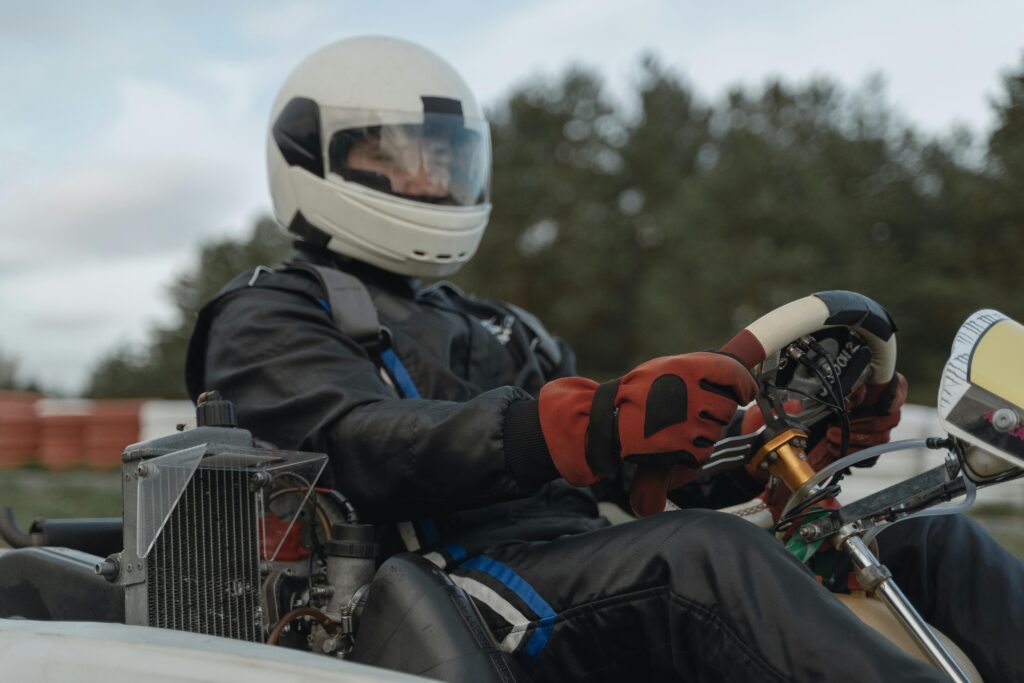
The biggest win is not your position. Its knowing “I was brave. I trusted myself. I did something hard”.
In eating disorder recovery, courage looks different but feels the same:
Eating out with a friend.
Not engaging in a behaviour, even when the urge is deafening.
Saying no, or saying yes, when it would be easier to avoid.
Those moments of perseverance, courage, and learning are sparkles in the recovery journey. We need to see them, name them, and celebrate them.
A sense of community
Among the dust, fumes and chaos, what stands out most about karting is the community.
I’ve watched men who barely know my son offer advice, spare parts, coaching, encouragement and genuine care. They see him because once they were him. They believe in him.
I don’t think we have fully harnessed the positive aspects of community in our eating disorder recovery pathways.
Recovery is too hard to do alone. We all need people slightly further down the track reminding us that it’s possible. People who can remind us of their own mistakes, adjustments, and learnings and invite us to find our own way forward. The ones who say, “keep going, you’ve got this, we’re with you”.
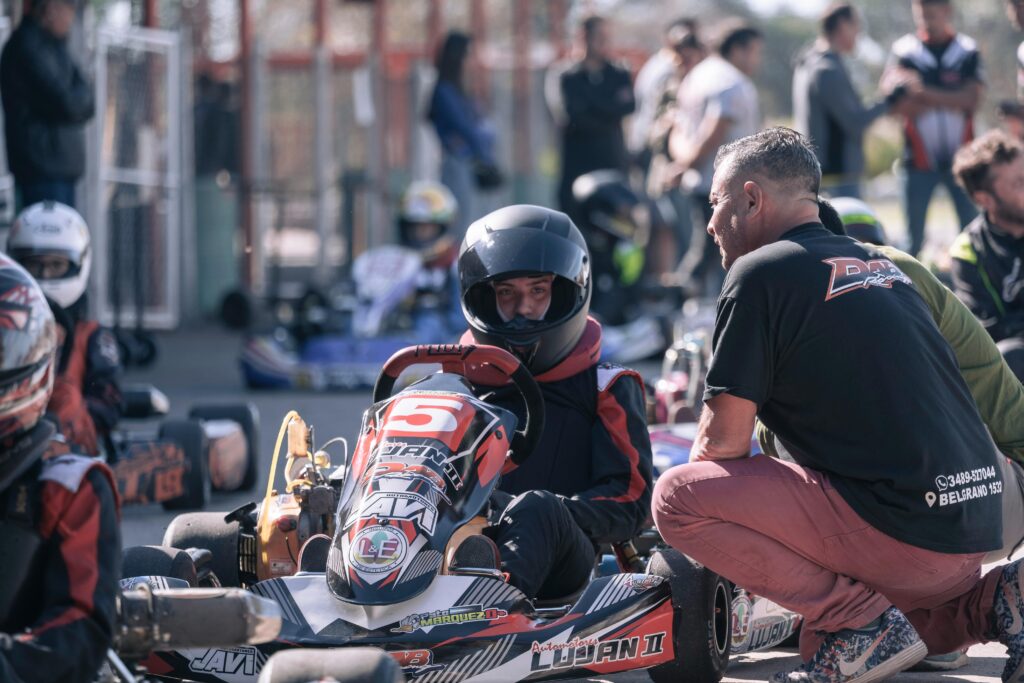
Recovery is too hard to do alone. We all need people further down the track reminding us it’s possible… the ones who say “keep going, you’ve got this, we’re with you”.
There is so much you can’t control
In karting, so much is out of your control. Engine failure. Someone else’s risky move. Weather changes. Equipment faults. A bad start.
In eating disorder recovery, the same is true: setbacks, plateaus, lapses, disappointment, exhaustion, doubt. These moments are not a sign of failure. They are part of the process.
What matters is what comes next:
Your mindset.
Your next step.
Your decision to keep going.
Recovery isn’t measured by the absence of setbacks but by the willingness to return to the track, again and again. And each time you do, you’re usually just a little further forward than before. That’s how we all grow.
It is about identity and so much more
Karting is more than just an activity for my son. It shapes the way he thinks, plans, saves, connects, dreams. It gives him belonging, direction, and identity.
This is so important for young people — and especially for those who missed parts of their adolescence due to mental illness or eating disorders.
If you ever have the chance to offer a young person a job, a trial, an opportunity, or an experience linked to something that lights them up — please do it. These experiences matter more than we realise in shaping healthy, hopeful humans.
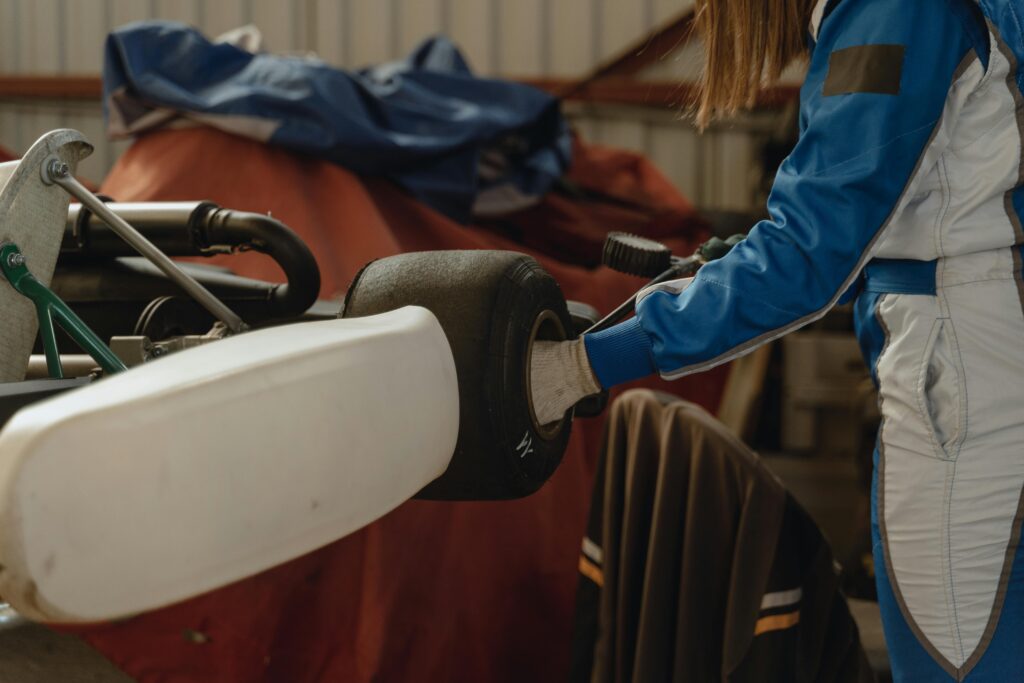
Go karting terminology that is relevant to eating disorder recovery
I’ve been learning some karting terminology which is surprisingly relevant to my work as a clinical psychologist working with individuals affected by eating disorders. Here are a few:
Apex — the innermost point of a corner on a racetrack where a driver aims to position their car as close as possible to the inside edge of the turn. Drivers choose different apex points based on their strategy and what is happening around them. It is the tightest, most vulnerable part of the turn. In recovery, the apex can be those difficult moments when you are closest to you fear… and also closest to change.
Racing line — A typical racing line involves entering a corner from the outside of the track, steering toward the inside to hit the apex, and then moving back to the outside as you exit. This path is longer than hugging the inside of the track throughout, but it lets you carry much more speed, making it faster overall. In recovery, the path that might look longer to others can be the smoothest pathway to building your own momentum, reducing harm, and aligning with healing.
Slipstream (Drafting) — when you follow closely behind another kart to reduce resistance. In recovery, this is the power of support — letting others take the lead, learning from those further along, allowing the presence of others to lighten your load.
Send it — a commitment. A risk. A brave move at speed. In recovery, “sending it” might be making a terrifying but necessary choice that aligns with your broader values. The choice to eat more to renourish your body, to learn to sit with intense emotions without binge-eating, to reach out and ask for help. It is making these brave moves even though part of you is terrified and wants to sit back and not take the risk.
Braking point — the point at which you start to slow down before a corner. This is the pause in therapy where you reflect, regulate, and choose your next move consciously — instead of reacting from fear.
Leaning into discomfort is how we grow
Go-karting was never my world. It is uncomfortable, time-consuming, expensive, loud and exhausting. But I am leaning into that discomfort because it has given my son a sense of self, purpose, drive and community. And through supporting his passion, it has given me a deeper understanding of courage, discomfort, connection, identity, setbacks, and recovery.
Maybe no recovery journey is neat or quiet or clean or comfortable.
Maybe it’s dusty, loud, uncertain, and uncomfortable. With intermittent moments of relief, excitement, accomplishment, and hope — only to go through it all again at the next turn, or the next time you’re back on the track.
And maybe… that’s exactly how it’s meant to be.
NOTE: The blog and all facts have been cross-checked by my karting-obsessed 16-year-old son, who gave me a wry smile and said it was “pretty good”, notably higher praise than I’ve received for any other content. I’ll take that as a win. We need more eating disorder content that speaks directly to boys and young men.
The opinions in this article are personal and are not intended as a substitute for professional medical advice, assessment or treatment. If you live in Australia and have concerns about an eating disorder or other mental health issues, supports are available through Butterfly Foundation Support for Eating Disorders and Body Image Issues | Butterfly Foundation and Lifeline Lifeline Australia – 13 11 14 – Crisis Support. Suicide Prevention.